
Printer on Rent vs Buying a Printer: Which Is Better for Office Use?
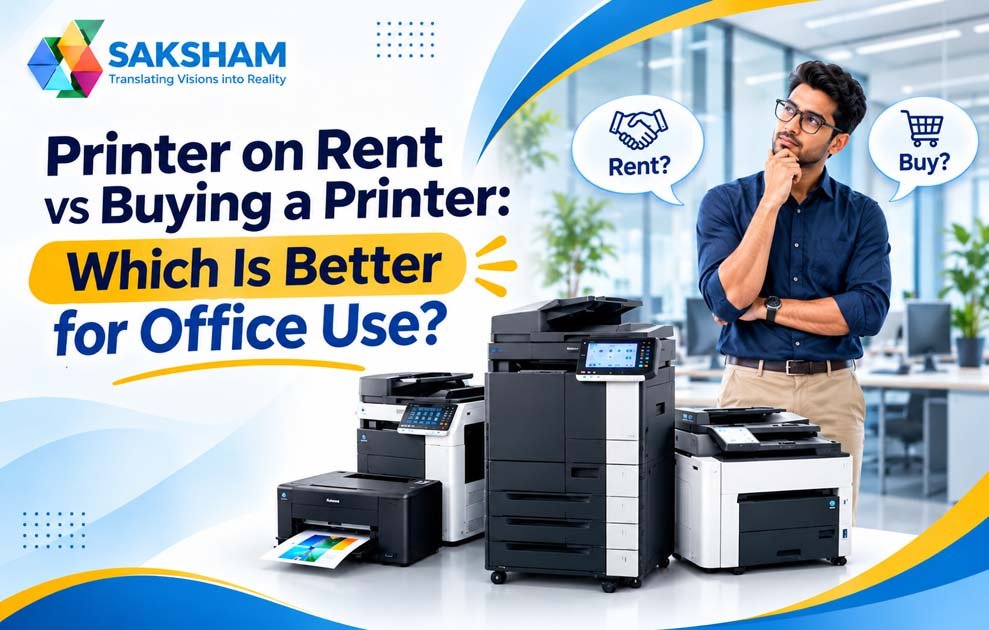
Choosing between renting and buying a printer is an important decision for businesses that depend on regular document printing. Both options have advantages, and the right choice depends on your office size, monthly printing volume, available budget, equipment requirements and long-term business plans.
Buying a printer gives a business ownership of the equipment, while renting allows it to use a printer under an agreed rental arrangement. For organisations that want to manage their initial equipment investment, printer rental can be a practical option. However, businesses with stable and predictable printing needs may also find purchasing suitable.
Saksham Office Automation provides printer and photocopier rental solutions for businesses exploring different office printing requirements. Understanding the differences between renting and buying can help you select equipment that supports your daily operations.
What Is the Difference Between Renting and Buying a Printer?
When a business buys a printer, it pays to purchase the equipment and becomes its owner. The organisation is generally responsible for arranging consumables, maintenance, repairs and eventual replacement, subject to any applicable warranty or service agreement.
When a business rents a printer, it uses the equipment for an agreed period and pays according to the rental terms. The agreement may specify monthly charges, usage limits, printing costs, maintenance responsibilities and other conditions.
Here is a simple comparison:
Factor | Printer on Rent | Buying a Printer |
Initial investment | Usually lower upfront equipment expenditure | Purchase price paid upfront |
Ownership | Equipment remains with the provider | Business owns the printer |
Maintenance | Depends on rental agreement | Generally arranged by the owner |
Equipment flexibility | May allow changes according to contract | Replacement requires another purchase |
Rental duration | Based on agreed contract | No rental contract required |
Printing charges | May include separate usage charges | Depends on consumables and operating costs |
Best suited for | Businesses seeking equipment flexibility | Businesses preferring long-term ownership |
The most suitable option depends on the complete cost of using the equipment rather than only its purchase price or monthly rental.
Why Do Businesses Choose Printers on Rent?
Many offices require printing equipment but do not necessarily want to purchase every machine they use.
A rental arrangement may be helpful when a company wants to manage equipment expenses, use a particular type of printer for a defined period or arrange printing capacity according to changing requirements.
- Lower Initial Investment
Purchasing commercial printing equipment may require a significant initial payment, particularly when a business needs multiple printers or advanced multifunction devices.
Renting can reduce the need for an upfront equipment purchase. Instead, the business pays according to the agreed rental structure.
This can help organisations plan their available funds for other operational needs, such as employee expenses, office infrastructure, technology upgrades and business development.
However, businesses should compare the total rental amount over the full contract period with the purchase and operating costs before deciding.
- Flexibility for Growing Businesses
A growing business may not know exactly how many printers it will need in the future.
An organisation may initially operate with a small team and later expand its workforce, departments or office locations. As a result, its printing requirements may increase.
Rental arrangements can provide flexibility depending on the provider’s available equipment and contract conditions.
Before signing an agreement, ask whether the machine can be upgraded, exchanged or supplemented if your printing requirements change.
- Access to Different Printing Equipment
Not every business needs the same type of printer.
Some organisations require basic black-and-white printing, while others need colour output, bulk photocopying or multifunction capabilities.
A rental provider may offer different equipment categories depending on availability and rental terms.
Businesses can explore printer rental services to understand the types of office printing solutions available.
- Maintenance Planning
Printer maintenance is an important part of office equipment management.
A business that purchases a printer needs to understand its warranty, servicing requirements, replacement parts and repair costs.
With a rental arrangement, maintenance responsibilities may be included in the agreement or handled through separate service conditions.
Always confirm what is covered. Do not assume that every rental plan automatically includes toner, spare parts, repairs or unlimited technical support.
- Suitable for Temporary Office Requirements
Some businesses require additional printing capacity only for a particular project, event, temporary office or seasonal workload.
Purchasing a printer for a short-term requirement may not always be practical.
A rental arrangement may be worth considering when the required duration, machine availability and contract conditions are suitable.
When Is Buying a Printer a Better Choice?
Although renting has several potential advantages, purchasing a printer may be the better decision for certain businesses.
- Your Printing Requirements Are Stable
If your business has consistent printing needs and expects to use the same equipment for several years, purchasing may be worth evaluating.
A cost comparison should include the purchase price, consumables, maintenance, repairs, electricity usage and expected equipment life.
- You Want Full Equipment Ownership
Some businesses prefer owning their office equipment.
Ownership gives the business control over how long it uses the printer, how it manages the equipment and when it chooses to replace it, subject to warranty and other applicable conditions.
- You Have an In-House Maintenance Arrangement
Companies with an established IT or office administration team may be able to manage printer maintenance internally.
In such cases, purchasing equipment may be a suitable option if the organisation is comfortable managing servicing, consumables and repairs.
- You Have a Defined Equipment Budget
If a business has allocated sufficient funds for purchasing printing equipment, ownership may be preferable.
However, the purchase decision should still consider future operating expenses and the cost of replacing equipment.
Printer Rental vs Buying: Which Option Is More Cost-Effective?
There is no universal answer because the actual cost depends on the printer model, printing volume, rental terms and ownership expenses.
Consider the following example.
A business needs one office printer for regular document printing. It has two choices:
- Purchase the printer and separately manage consumables and maintenance.
- Rent the printer under an agreement with defined monthly charges and usage conditions.
To compare the options, calculate the following:
Total ownership cost:
Purchase price + consumables + maintenance + repairs + other operating expenses.
Total rental cost:
Rental charges + usage charges + deposits or additional fees + any services not included in the agreement.
The business should compare these costs over the same period.
For example, comparing a one-year rental arrangement with the purchase price alone would not provide a complete picture. Similarly, comparing a printer purchase without considering consumables and maintenance could produce an inaccurate result.
The right decision comes from understanding the complete cost of using the equipment.
Which Type of Printer Should Your Office Choose?
Once you decide whether to rent or purchase, the next step is selecting the correct type of equipment.
- Standard Office Printer
A standard printer may be suitable for offices that mainly need to print invoices, letters, reports, internal documents and other routine paperwork.
Before selecting one, consider the number of users, expected monthly print volume, printing speed and connectivity requirements.
- Multifunction Printer
A multifunction printer combines several document-related functions in one machine.
Depending on its model, it may support:
- Printing
- Scanning
- Photocopying
- Network printing
- Document handling
This type of equipment can be useful for workplaces where employees regularly perform multiple document-related tasks.
Businesses that need combined printing and copying functions can explore multifunctional printers on rent from Saksham Office Automation.
- Photocopier Machine
A photocopier is useful for businesses that regularly reproduce physical documents.
Schools, colleges, consultancy offices, administrative departments and corporate workplaces may require photocopying for forms, reports, agreements and other paperwork.
Businesses with frequent document-copying requirements can consider photocopier machines on rent according to their usage needs.
- Colour Printer
Colour printing may be important for businesses that prepare presentations, marketing materials, charts, reports, diagrams and other visual documents.
Before choosing a colour printer, understand its colour printing capabilities, supported paper types, expected usage and printing charges.
Factors to Consider Before Renting an Office Printer
If you decide that renting is more suitable, evaluate the following points before selecting a provider.
Monthly Printing Volume
Estimate how many pages your office prints each month. Consider both black-and-white and colour printing.
Number of Users
A printer used by two employees may have different requirements from a machine shared by several departments.
Printing Speed
Consider how frequently employees need printed documents and whether delays could affect office operations.
Paper Size and Handling
Check which paper sizes and types the machine supports. Some workplaces may need different paper formats for reports, forms and other documents.
Connectivity
Understand whether the printer supports the connectivity options required by your workplace, such as USB or network printing.
Rental Contract
Check the rental period, payment terms, usage conditions, maintenance responsibilities and equipment return policy.
Technical Support
Understand how to report technical issues and what support arrangements are included in the agreement.
How Saksham Office Automation Can Help Businesses Explore Printer Rental Solutions
Saksham Office Automation offers information about printer, photocopier and multifunction equipment rental options for businesses.
Different organisations have different document workflows. A startup may need a printer for everyday administrative work, while a larger office may require equipment for frequent printing, scanning and photocopying.
Before choosing a machine, businesses should identify their expected workload, required features and preferred rental duration.
Saksham Office Automation provides dedicated service information for different equipment categories, helping businesses explore options according to their office printing needs.
The right equipment selection should focus on suitability, usage requirements and the terms of the rental agreement.
Common Mistakes to Avoid When Renting or Buying a Printer
Choosing Only on the Basis of Price
A low purchase price or rental amount does not necessarily mean the equipment is the most suitable choice. Compare the total cost and machine capabilities.
Ignoring Monthly Printing Requirements
Selecting equipment without estimating print volume can result in an unsuitable machine.
Not Checking Consumable Costs
Toner, ink, paper and other consumables can contribute to the overall cost of printing.
Overlooking Maintenance
Understand who is responsible for repairs and servicing before entering into a rental agreement or purchasing a machine.
Selecting Unnecessary Features
Do not choose advanced features unless your workplace actually needs them. The machine should match your document workflow.
Not Comparing the Full Contract Period
Always compare rental and ownership costs over the same period.
Frequently Asked Questions
- Is it better to rent or buy a printer for office use?
It depends on your budget, printing volume, equipment requirements and expected usage period. Renting may suit businesses seeking flexibility and lower initial equipment expenditure, while buying may suit businesses that prefer ownership and long-term use.
- What are the benefits of renting a printer?
Printer rental may reduce upfront equipment investment, offer access to different machine types and provide flexibility according to rental terms. Maintenance support may also be available depending on the agreement.
- Is a printer on rent suitable for small businesses?
Yes. Small businesses can consider renting a printer when they need office equipment but prefer not to make a large initial purchase. The rental arrangement should match their budget and printing requirements.
- What is included in an office printer rental agreement?
The agreement may include equipment details, rental charges, contract duration, usage conditions and maintenance responsibilities. Consumables, repairs and technical support should be checked separately.
- Can I rent a multifunction printer for my office?
Yes. Multifunction printers may be available for rental depending on the provider and equipment availability. These devices can combine printing, scanning and copying functions.
- Does renting a printer reduce office printing costs?
It may help manage upfront equipment expenditure, but it does not automatically guarantee lower total printing costs. Compare rental charges, usage fees, consumables and other expenses before deciding.
- What is the difference between a printer rental and printer leasing arrangement?
Both involve using equipment without purchasing it outright, but their legal and commercial terms can differ. The contract should clearly explain duration, payments, ownership, servicing and end-of-agreement conditions.
- Which printer is best for a corporate office?
The suitable printer depends on the number of employees, monthly print volume, document types and required features. Corporate offices may consider standard printers, colour printers or multifunction devices.
- Can I rent a photocopier instead of buying one?
Yes. Businesses can explore photocopier rental arrangements when they need regular document copying but prefer not to purchase the machine. The equipment and contract should match their expected usage.
- What should I check before selecting a printer rental company?
Check equipment suitability, monthly rental charges, printing fees, maintenance responsibilities, consumables, technical support, contract duration and service conditions.
- Can printer rental arrangements be changed when business requirements increase?
This depends on the provider and rental agreement. Ask whether equipment upgrades, additional machines or changes in usage limits are possible.
- How do I calculate the total cost of renting a printer?
Add the rental charges, per-page or per-click fees, deposits and any additional services or consumables not included in the agreement. Compare this with the complete cost of purchasing and operating a printer over the same period.
Conclusion
Choosing between renting and buying a printer requires a clear understanding of your business’s printing requirements and budget.
Renting may be suitable for organisations that want to reduce upfront equipment expenditure, access different types of printers or maintain flexibility. Buying may be appropriate for businesses that prefer ownership and have stable long-term requirements.
The most important step is to compare the complete costs and select equipment that supports your daily office operations.
Saksham Office Automation provides printer and photocopier rental solutions for businesses exploring office printing options.
Visit the website to learn more about available services:
https://www.sakshamoffice.com/
Contact Saksham Office Automation to discuss your office printing requirements and explore a suitable rental solution.